
[Critique] The Girl 'Smile' is the Aesthetics of the AX Era - Shim Jung Taik
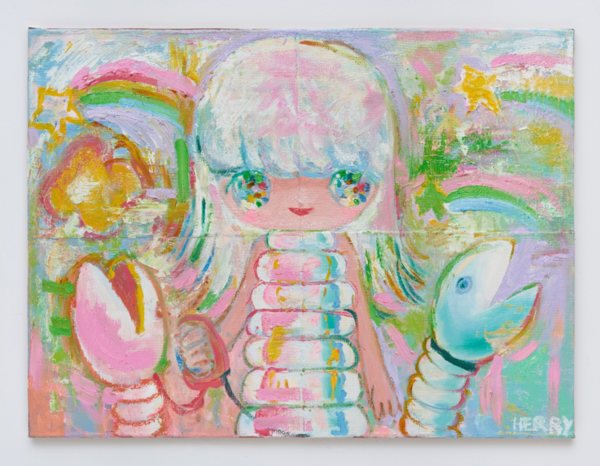
Solo Exhibition <Herry Kim: A Tender World> at Tte Art Gallery, Seoul, through the 30th
Herry Kim, an artist who came of age during the peak of the digital era, has focused on painting for the past two years, breaking free from the boundaries between flat and post-flat, analog and digital. In the meantime, the age of AI has arrived in full force.
Having been immersed in contemporary art through education and professional practice both domestically and abroad, Herry Kim realized that the process of "image assemblage" (mediated through photography sourced from the internet) inevitably forces a focus solely on the image itself. She observed that "virtual realism" implemented on a flat surface often drains the inherent power of the original image. During her university years, she felt that simply arranging images perceived through photography onto a canvas lacked a clear connection to the fundamental question of "what to express." The lingering question remained: what is the ultimate significance of distinguishing between digital and analog?
In graduate school, she experimented with three-dimensional works, using 3D printing to extract video work created in 2-dimensional digital media. On the other hand, her preoccupation with non-material work was partly due to the physical strain of moving traditional painting tools like easels.
Since childhood, the artist has been fascinated by dolls, collecting hundreds of fashion dolls such as Blythe and Barbie. She was drawn to the textures—so different from human hair—the exaggerated expressions, and their distinctive features. Drawing motifs from these dolls that accompanied her youth, she named her persona "Smile."
While establishing her strategy as a professional artist, she decided to lead her narrative through "Smile" as the narrator, fully engaging with the classical medium of the canvas. Her choice was also driven by the fact that painting, centered on line and color, yields immediate results.
Technological advancement is accelerating. Only a few years ago, the world was calling for DX (Digital Transformation), but we have already entered the eras of AX (AI Transformation) and IX (Intelligent Transformation). AI no longer stays within the display; it has ushered in the age of "Bots" with physical entities, such as humanoid robots and autonomous vehicles. In the AX era, while one can command AI to generate images through text, AI cannot derive the conscious and unconscious sensory experiences an artist undergoes during the creative process.
The artist projects a prayer into "Smile"—a character that covers the analog, digital, and AX realms—wishing that no misfortune befalls it and that it remains happy. She hopes "Smile" will serve as a guide for her work, both now and in the future.
Herry Kim was once influenced by the "Kawaii aesthetic" of artists like Yoshitomo Nara and Takashi Murakami, whose works seem to explain complex ideas through a raw yet accessible lens. However, Kim’s path is different. The character "Smile" in her work is a tool (a device) for questioning a world of contradictions—human dignity versus atrocity.
During the COVID-19 pandemic, experiencing a total shift to digital work due to physical space constraints, Kim reached the realization that an expression-oriented artist must evolve alongside "color." Since moving her studio from Los Angeles to Seoul two autumns ago, she began creating large-scale works.
Regarding her recent large-scale works, which may seem unfamiliar or disproportionate at first glance, the artist does not differentiate between "painting small" and "painting large." When an image comes to mind, she simply selects the appropriate material and medium. The exhibition space and the workspace are proportional; works are created to fit the exhibition space, or the size is determined within the studio first. The exhibition <Herry Kim: A Tender World> features larger works compared to her previous series.
The character "Smile" is cute and friendly, reminiscent of the Michelin Man. The motif was drawn from the sight of people wearing puffer jackets with shorts on the California coast in winter, where the artist studied and worked.
The artist likens the process of painting to the creation of dolls. She notes that modern dolls are similar to ancient Towoo (clay figurines), which were ritualistic and religious. Ancient Towoo encompasses small clay sculptures of human, animal, and divine forms produced across societies. In ancient Egypt, human-shaped dolls made of wood or clay have been found dating back to 2,000 BCE.
The concept of the plagon—ancient Greek dolls—is often invoked today when interpreting dolls in connection with socialization, gender, ritual, and body image. Ball-jointed dolls, also made during the Greek and Roman eras, were later reimagined by the modern German Surrealist Hans Bellmer (1902–1975). Bellmer’s series from the 1930s presented what Freud called the "Uncanny" (Das Unheimliche), and he is evaluated in art history for his political resistance and radical reinterpretation of the body.
Dolls are the result of the enduring human desire to create "human figures" and the continuation of their social functions. The artist’s explanation—that modern dolls like Barbie and Blythe originate from ancient Towoo—inherits the tradition of assigning play and cultural significance to human replicas.
Projecting her wish that "Smile" has embodied human aspirations since ancient times, the artist allows "Smile" to act freely as it desires, whether on canvas or within physical space. For Herry Kim, who has worked across painting, sculpture, and media art, the dilemma of “which medium to speak through” is ultimately a question of which materiality and spatiality can most truthfully reveal her essence.
As the digital realm becomes dominant, analog traces of the hand, materiality, and "aura" have acquired new meaning, though their definitions remain fluid. Furthermore, in an era of AI-generated imagery, the artist must find her own answers through her practice to questions such as: "What is the significance of the artist’s hand-painted work?" and "What value does the physical property of sculpture hold in the age of 3D printing?"
Herry Kim’s aspiration is for a "tender and peaceful world," but reality has entered an age of uncertainty, where post-war hegemony is solidified and a new form of imperialism has emerged. What can an artist do?
"The real world may not be ideal, but as an artist, I want to show a world of work that carries a wish for people to find peace and to let them know that life is worth living and that a tender world exists."
The exhibition <Herry Kim: A Tender World>, featuring about 40 pieces including ceramic doll heads reminiscent of Towoo, runs through the 30th at Tte Art Gallery in Pyeong-dong, Jongno-gu, Seoul.
Source: Newsverse (Written by Shim Jung Taik, Art Columnist)
Full Article(Korean): https://www.newsverse.kr/news/articleView.html?idxno=9442
