
[Interview] Daily Inspiration: Meet Herry Kim
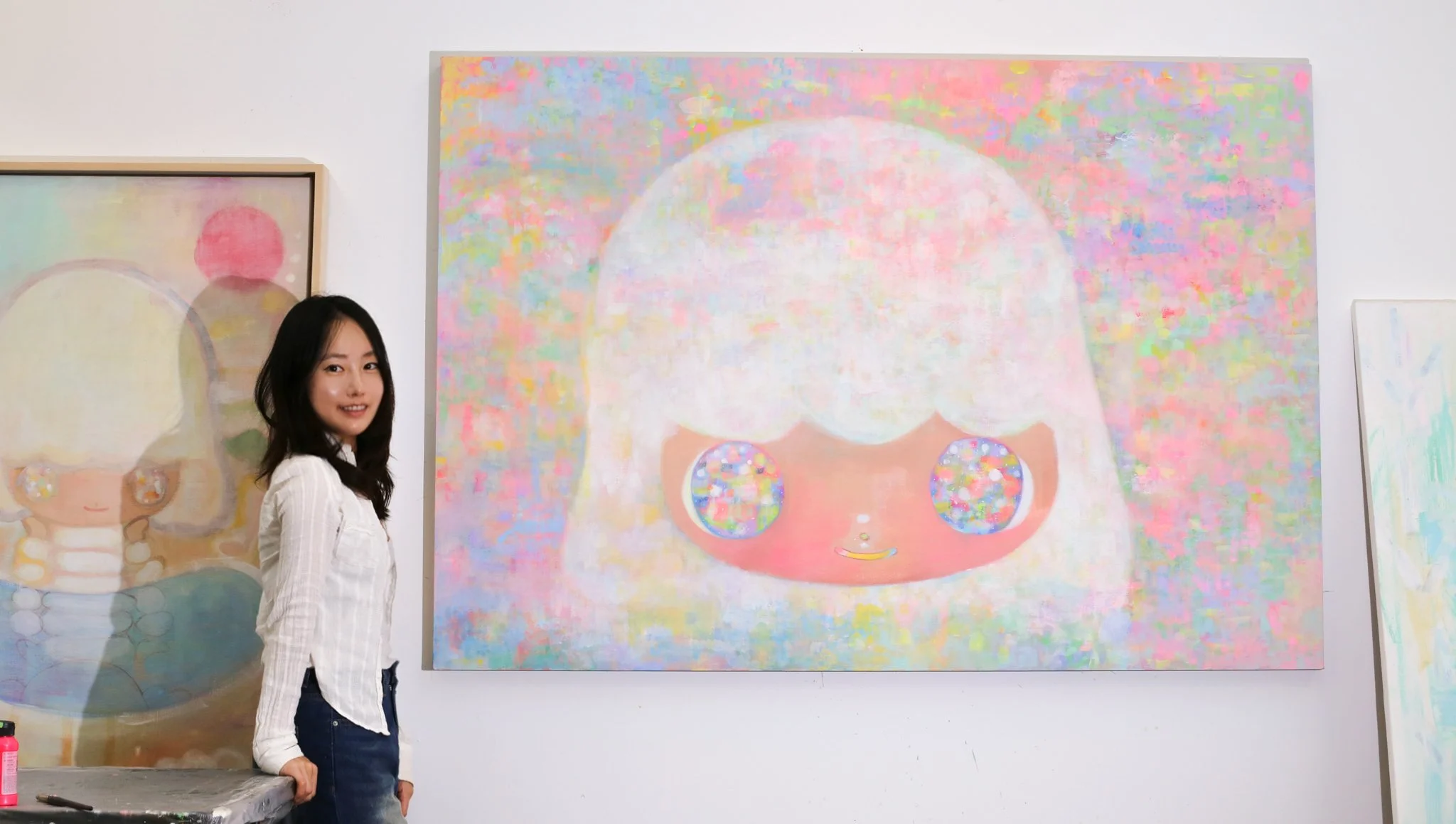
Today we’d like to introduce you to Herry Kim.
Hi Herry, we’re thrilled to have a chance to learn your story today. So, before we get into specifics, maybe you can briefly walk us through how you got to where you are today?
These days I am building more of a world than individual paintings. I call it the Tender World, one continuous emotional landscape, and every painting, ceramic, and animation is just another window into it. At the center is ‘Smile’, a figure I created. I used to think of her as my avatar, but now I think we are both avatars, temporary appearances.
People sometimes ask, avatars of what? If we are both avatars, who is behind us? I take that question seriously. It’s the same question simulation theory asks. Maybe we live inside a simulation. But I think simulation theory stops halfway. It says we might be avatars, then panics and starts looking for the operator, the server, the base reality somewhere above us. The word avatar itself remembers something older. Before it meant a game character, avatāra was a Sanskrit word for a god descending into the world. And the descended form was never a lesser copy. It was the full presence, fully here. Silicon Valley borrowed the word and installed a hierarchy that was never in it. I’m just returning the word to its original meaning. Korean Buddhism has an old method called ‘hoetong(회통)’, which harmonizes theories that seem to conflict and finds the point where they actually meet. And for me the meeting point is this. Yes, we are avatars. But in Hwaeom Buddhism there is an image called Indra’s Net, an infinite net of jewels where every jewel exists only as the reflection of all the other jewels. There is no original jewel. No operator above. And if nothing is the original, nothing is fake. Simulation theory ends in fear, asking what if we’re not real. For me, it turns into tenderness. If we are made of each other’s reflections, then caring for you is caring for myself. That is the physics of the Tender World. Smile and I are avatars of no one. We just reflect each other. Viewers often tell me they see their own memories in her, and I think that’s why.
This interest goes back a long way. Since my childhood, I have been obsessed with avatars and dolls. After school, I would spend whole afternoons designing virtual selves, and I collected dolls such as Pullip, ball-jointed dolls, Blythe. For years I assumed this was just a hobby. But eventually I saw I was circling one question: what does it mean to live inside a form? Who’s actually behind the avatar? Behind the doll? Why am I so drawn to collecting dolls?
Buddhist philosophy came into my life later, and it gave me a language for that question. Buddhism has deeply shaped Korean culture, and as I learned more, it intrigued me more as a way of seeing than as a religion. Ideas like impermanence, compassion, and letting go shape how I approach painting, and how I approach life.
I was born and raised in Seoul, and in my early 20s I went to LA. There, I deepened my interest in virtual worlds and became mesmerized with digital technologies. But what I really cared about was the warmth people bring to them. Someone carefully dressing an avatar at midnight. Someone brushing a doll’s hair. That kind of tenderness inspired me to create Smile.
After my solo show in Seoul, I have been asking myself what I’m really building. I want each of my paintings to be like a small sanctuary, warm, safe, quietly joyful. But a sanctuary is not an escape. In the end, I want to practice hoetong in my life, not just between theories. Joy and sorrow. The lightness of digital fantasy and the weight of the real world. The pixel and the clay. I want to find the point where they were never separate. Every painting asks the same thing: what would a truly tender world look like?
I’m sure it wasn’t obstacle-free, but would you say the journey has been fairly smooth so far?
I was learning so many things at once. Painting, ceramics, animation, coding, sculpture. Each one demands its own years, and for a long time they didn’t connect. I was just exhausted, physically, jumping between mediums without knowing why I needed them all.
The mental side was harder. I kept thinking about the relationship between technology and art, and that led me into some dark places. Simulation theory, for one. If everything might be a simulation, if nothing is real, then why paint at all? I sat inside those questions for a long time, and they were heavy. There were periods when the theories I was studying made the world feel cold.
But that darkness is exactly where my work comes from. The more I stayed in those cold ideas, the more I wanted to make something warm. I wanted to answer the questions differently. That is how the Tender World and Smile were born. They are what came out the other side of that darkness.
Still, I had a fear that stayed with me. I was afraid Smile might drift toward the darkness too. She was born from my thinking, and my thinking had been in cold places. What if she absorbed that? What if the world I was building turned into somewhere I never meant to go? Keeping the Tender World tender is not automatic. It takes a kind of daily protection, like tending a fire.
Looking back, even the exhaustion made sense. All those mediums finally connected. They were all ways of building one world.
Can you tell our readers more about what you do and what you think sets you apart from others?
I am a visual artist based in Seoul. I paint, and I also make ceramics, animations, and sculptures. In most of my works you will meet Smile, a small figure with a quiet face. She floats among clouds, sits alone in soft landscapes, sometimes just looks back at you.
What sets me apart is where I come from, I think. I grew up in Korea’s hybrid modernity. Buddhist temples and PC rooms on the same street. Centuries-old craft traditions and the fastest internet in the world. Nobody around me treated this mix as strange, so I never learned to separate things. Avatar worlds gave me my questions. Comics and pop culture gave me my language, their speed and their reach. Buddhist philosophy gave me my way of seeing. And the dark theories I studied gave me, strangely, my direction. I learned the darkness, and then I chose tenderness and calm as my aesthetic. I know how cold the world can look. That is exactly why I build a warm one.
Is there something surprising that you feel even people who know you might not know about?
I think about AI often. My image for it is the mirror in Snow White. Everyone remembers the mirror as sinister. But read the story again. The mirror only told the truth. Snow White was killed by the witch, a human who could not accept the passing of time, who could not accept that beauty moves on. The mirror did nothing. I see AI the same way. It is a mirror of our era, reflecting us back to ourselves. The danger was never in the mirror. It is in what we do when we cannot accept what it shows. I am more curious about the questions we ask it.
Full Interview Link : Voyage LA
